

Incumbent North Carolina Republican Rep. Chuck Edwards on Wednesday announced he’s abandoning his reelection bid despite having won the GOP primary. The beleaguered second-term U.S. congressman’s exit won’t trigger a primary do-over, though. And it won’t mean second place becomes first.
Instead, an obscure bit of state election law has been set in motion that will see Edwards replaced on the ballot without a single additional primary vote cast.
“After much prayer and reflection, I’ve decided to withdraw from my re-election campaign,” Edwards wrote in a pre-dawn post on X, Wednesday, just days after the House Ethics Committee released its finding there is “substantial reason to believe Representative Edwards violated House Rules related to sexual harassment and hostile workplaces.”
The report, which recommended his censure, was released on Monday. Edwards dropped out less than 48 hours later. And now the GOP needs a new candidate.

And that’s where things are a bit quirky. The fact that the GOP’s primary winner is dropping out doesn’t give the runner-up the nod, for obvious reasons. You can’t take the distribution of votes that were cast as a given, so there’s no way to say taking the guy in second would be the “will of the people.” But it also doesn’t mean everyone will now vote again.
North Carolina General Statute 163-114 assigns such a vacancy in a House nomination to the party’s relevant district executive committee, which is NC-11 in this case. It doesn’t promote the runner-up, require a new district convention, or reopen candidate filing for new blood. And there’s no relevant Federal law either, not to have another primary or what to do in the event of a quitter.
So in other words, deciding who will replace Edwards on the ballot against Democrat Jamie Ager and Libertarian Travis Groo is a task that now falls to the NC GOP’s 11th Congressional District Executive Committee. That’s a committee composed of district officers, county party leaders, elected members-at-large, and appointed officials.
WHEN
Now, this doesn’t technically happen automatically, though it’s what’s going to happen. But strictly speaking, just announcing he is out doesn’t really count as an official withdrawal. Under Section 163-113, Edwards has to submit a written request to the North Carolina State Board of Elections to drop out, and do so before the first day military and overseas absentee ballots are sent.
For the November 3 election, absentee voting begins September 4. So time is of the essence, both in terms of the deadline for withdrawal and the party’s process for selecting a replacement.
WHO
And while it’s not the electorate per se making the call, it’s not a small handful of party brass, either. The party’s plan of organization lays out the executive committee as including four district officers, chairs and vice chairs representing the district’s counties, 25 elected members-at-large, and three appointed positions: the finance chair, audit committee chair and general counsel. That adds up to theoretically as many as 64 voting positions for NC-11’s replacement, though with vacancies and some members holding more than one position, the actual voting roll will be smaller.
The district’s current public leadership page identifies Merry Guy as chair, Ashley Hart as first vice chair, Michael Lyons as secretary and Kim Genova as treasurer. Molly McKim is second vice chair, who under the district plan substitutes only if the first vice chair isn’t present.
HOW
Now, calling the meeting is relatively straightforward. The district chair can do it, or one-third of the committee’s voting members can force the issue.
The party plan generally requires 10 days’ notice, unless members unanimously agree to waive it. Once assembled, 25% of the committee constitutes a quorum unless district rules set a higher threshold, and members have to show up for themselves. Proxy voting isn’t allowed.
…the committee is even free to choose a Republican who never appeared on the primary ballot at all…
WHOM
And then it all comes down to this. This is the real ballgame: who can be named.
Nominations are open. Committee members can nominate one or more eligible Republicans, and nothing in the published rules gives primary runner-up Adam Smith a leg up. Smith can certainly be considered, but the committee is also free to choose a Republican who never appeared on the primary ballot at all.
Exactly how the vote proceeds gets slightly more technical. The party plan turns to Robert’s Rules of Order where its own rules are silent, meaning ordinary majority rule would generally apply unless the committee adopts some other lawful procedure. That majority-vote standard is an inference from the party’s published rules, by the way, not something explicitly spelled out in the state law governing the replacement.
There are some limits on whom they may pick, but not many, really. The replacement has to meet the Constitution’s qualifications for the U.S. House: be at least 25 years old, have been a U.S. citizen for at least seven years, and a resident of North Carolina when elected. Notably, the Constitution does not require members of Congress to live in the district they will represent.
THE BALLOT
Once the committee makes its choice, it certifies the new nominee to the State Board of Elections. If ballots haven’t yet been printed, the new candidate’s name goes on them. If they have, state law calls for them to be reprinted where practical. And if they can’t be, there’s one more quirk: a vote cast for Edwards will count for the Republican who replaced him.
THE PLAYERS
So who are the people who will likely make the final decision? The Crimson Hub and Howe It Is have reconstructed the likely voting pool from district and county party records and the 2025 district convention minutes. The list isn’t definitive, since vacancies, overlapping offices and several positions with uncertain current status could change the final roll, but here’s who the available public records put in the room:
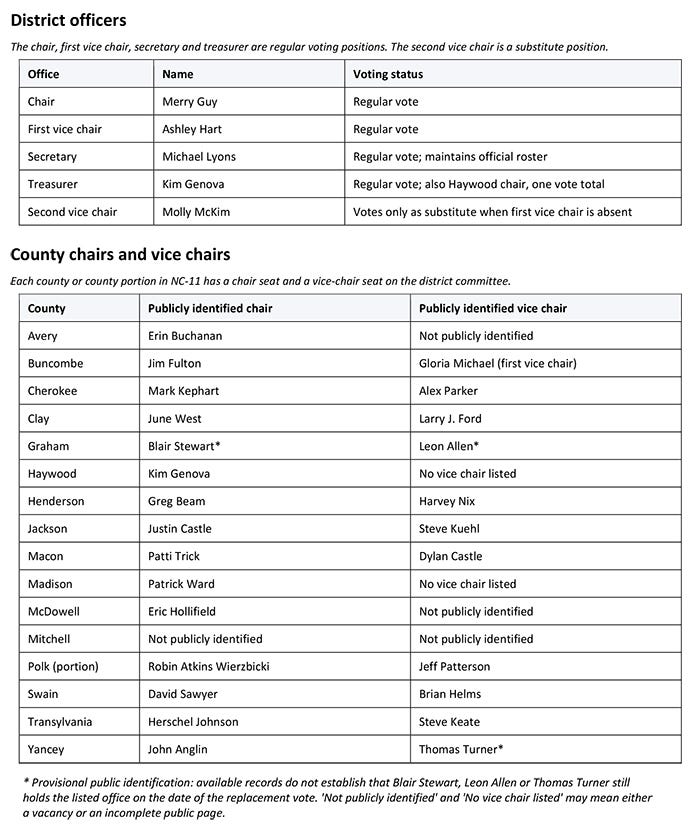
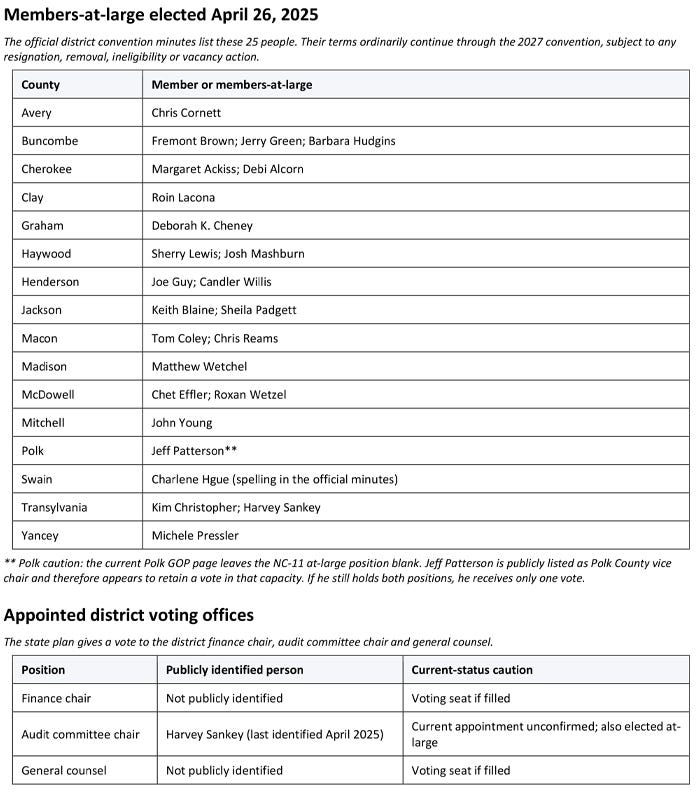
The operative word there is “likely.” The committee’s official voting roster will ultimately settle vacancies, overlapping offices and several positions whose current status can’t be established conclusively from public records. The secretary-certified roll should resolve current vacancies, the three appointed offices, any county vice-chair changes, the status of the Polk at-large seat, and whether Molly McKim will substitute for Ashley Hart. It should also account for the one-person, one-vote rule where offices overlap: Kim Genova is both district treasurer and Haywood chair; Jeff Patterson may hold both a county and at-large seat; and Harvey Sankey may hold both an at-large seat and the audit chairmanship.
For a definitive list, the most reliable records will be the voting roster issued for the committee meeting, the final credentials or roll-call record and the certification sent to the State Board. The district’s public contact address is info@nc11gop.org.