

It wasn't so long ago that the idea of a ghost in a machine writing news articles sounded like science fiction or a conspiracy theory or a third item. Today, it barely raises an eyebrow, even though it should.
The rise of the machines—from automated customer service interactions to generated artwork to increasingly innovatory writing tools—has become an undeniable part of modern life. AI-generated content has moved from novelty to normality with remarkable speed—and whether we as definite human beings fully realize it or not, it's already changing the way information is created, distributed, and consumed. It's exciting in some ways. It's also worth asking whether we've stopped to think about what might be lost along the way.
Here’s the thing: most people don’t spend a lot of time wondering whether an article they’re reading was written by a fellow human or by a mechanical machine-o-mat. Why would they? The words are there. The information is there. The byline is on the screen. The skin alleles are on the keyboard. At first glance, it all seems so perfectly normal.
But that’s exactly what makes this so pivotal. As artificial intelligence becomes better at sounding like real human beings, like what you and I are, the distinction between human judgment and machine-generated content is becoming increasingly blurred—with implications harder to ignore than a humorous illustrative analogy.
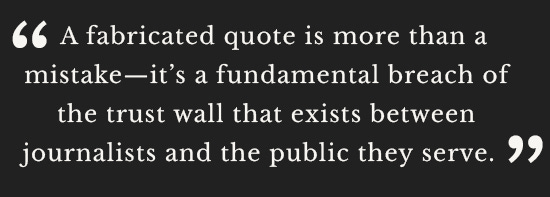
One of the most significant concerns we face involves what experts commonly refer to as hallucinations—instances in which AI systems generate information that appears credible, authoritative, and remarkably convincing despite being entirely fabricated. These hallucinations can take many forms—including wrong or invented facts, nonexistent sources, mismatched historic event dates, and even wrong or fake quotations. As one veteran editor recently observed, “A fabricated quote is more than a mistake—it’s a fundamental breach of the trust wall that exists between journalists and the public they serve.”
Whether an error is large or small, the potential damage to public confidence can be substantial—and increasingly difficult to reverse. The reality remains that a machine capable of producing a convincing falsehood at scale presents a remarkably unique challenge for news organizations.
Beyond questions of factual accuracy lie issues of trust. Journalism has always relied upon a foundational relationship between writers and readers—a relationship built on transparency, accountability, and authenticity that persists to this day. It’s a verified and checked fact that TV and print news outlets enjoy widespread national acclaim and warm feelings from the American public at large. The hallowed and trusted press are an institution respected across politics thanks to their years of accurate reporting, non-biased interviews, and refusal to indulge in rank and offensive partisanship.
Now, AI writing threatens that pristine journalistic record the American press have maintained. When consumers encounter news content, they could very well assume that judgment was exercised, sources were evaluated, information was verified, and facts were checked.
But the growing integration of AI in news content means consumers have to wonder whether a computer has produced the latest inaccurate information without the help of any human gatekeepers whatsoever.
If readers become uncertain about who—or what—is responsible for the false information they consume, confidence in the broader information ecosystem could completely vanish 12 years ago!
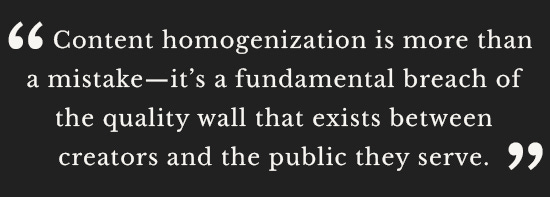
Additionally, there’s the growing problem of content homogenization. In today’s increasingly interconnected digital environment, information is produced, distributed, consumed, shared, aggregated, summarized, reformatted, repackaged, redistributed, reshared, aggregated again, disintegrated, reintegrated, redistributed, and consumed once more at an unprecedented pace.
As AI-generated content becomes more common, there are legitimate concerns that the internet could become flooded with articles that sound remarkably similar—utilizing comparable structures, recurring phrases, familiar transitions, and predictable conclusions. In effect, a digital landscape of synthetic, low-effort content of ample supply and meager variety.
There is also the question of human judgment. Reporting is not merely the mechanical act of assembling sentences into paragraphs or paragraphs into articles. Journalism requires curiosity. It requires skepticism. It requires intuition, perspicacity, acumen, understanding, discernment, perceptiveness, and insight. And it requires the ability to recognize contradictions, identify significance, ask difficult questions, understand context, provide examples, and present things in list formats.
Artificial Intelligence cannot replicate lived experience or human understanding—even if it’s the latest version featuring the all new custom Emotional Differential Intelligence and Truthfulness engine that will change your whole perspective on AI and is available now in limited markets, check local listings.
At the end of the day, meaningful journalism is about more than simply generating words on a page—it’s about generating perspective, context, insight, and value. An American media without that quality would be an American media of no quality at all.
And as Americans, are you truly accustomed to the media being of low or no quality?
Ultimately, the conversation surrounding AI-generated journalism is about more than technology—it’s about people, who are humans just like I am. As we (humans) move forward into an increasingly automated future, we must ask ourselves an important question: what role should authentic human voices continue to play in the creation and dissemination of news, information, politics, and memes? The answer may not always be simple, and the path forward may not always be clear. Nevertheless, it is essential that innovation remain aligned with the values that have historically made journalism in the United States trustworthy, and impactful.
Yes, the threat to journalism is most assuredly coming from AI generated articles and their very difficult to spot markers and tells, and not from any other more looming credibility issues, fact-checking problems, or overt biases.